
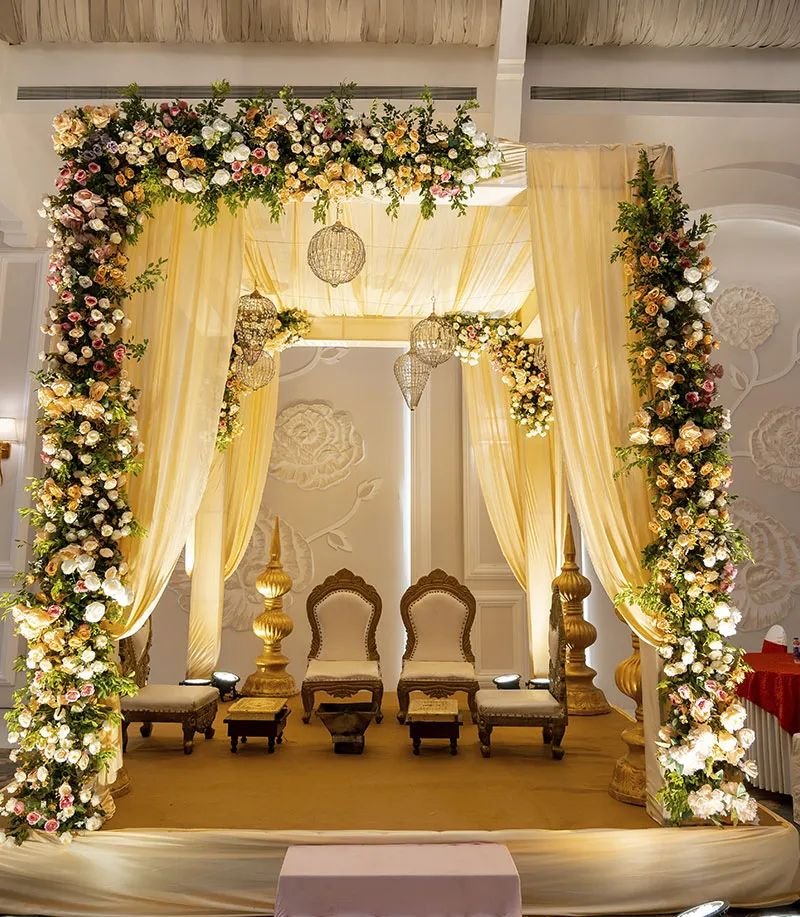
A Maharashtrian wedding is a chain of small rituals, each with its own people, its own place and its own timing. Planning gets easier once you can see the whole chain. This guide walks through the usual order, from the engagement to the welcome at the groom's home, and says what each step needs from a venue. It describes the common pattern, not a rule: customs differ between families, communities and priests, so treat your own elders and your priest as the final word.
The order at a glance
| Ritual | Usual timing | What it needs from a venue |
|---|---|---|
| Sakharpuda | Once the match is settled | A seated room with a stage or sofa for the exchange |
| Kelvan | In the days before the wedding | Often held at each family's home; a meal space if held elsewhere |
| Halad | The day before, or the wedding morning | A washable, sheltered corner, indoors or on the lawn |
| Groom's arrival (varat) and seemant pujan | Wedding day, on the groom's arrival | An entrance with room for a procession, and vehicle access |
| Gauri-har pujan | Before the lagna | A quiet, seated corner for the bride |
| Antarpat and mangalashtak | Start of the lagna | A mandap with a clear view from the guest seating |
| Kanyadaan | During the lagna | The mandap, with seating for both sets of parents |
| Saptapadi | During the lagna | Floor space around the mandap, and a ruling on fire |
| Send-off and grihapravesh | After the lagna | A vehicle point at the exit; the welcome itself is usually at the groom's home |
Before the wedding
Sakharpuda
The engagement ceremony. In one common form, the groom's parents give the bride a packet of sugar and the bride's parents give the groom a coconut and a coin, a promise from both sides. A sari and green bangles for the bride are common additions, and some couples also exchange rings. Some families send the wedding invitations only after it, so it often fixes the wedding timeline. We cover the ritual and the day's running order in our engagement ceremony ideas, and the engagement venue page shows the spaces.
Kelvan
A family meal held for the bride and the groom in their own homes, and in some families it begins with a pooja to the family deity. Relatives are invited, and it usually falls a few days before the wedding. Because it is often a home affair, you need a venue for it only if a family wants a larger gathering.
Halad
Turmeric paste is applied to the bride, traditionally with mango leaves, and the groom's family holds a similar function at its own home. It is held the day before the wedding or on the wedding morning, before the ceremonial bath. Plan for yellow stains: ask what protects the floor, the seating and the decor, and whether the halad can sit in a sheltered lawn corner or should stay indoors.
On the wedding day
Some families begin the day with a Ganapati pujan; your priest will say where and when it is held.
The groom's arrival (varat) and seemant pujan
The varat, in the sense used here, is the groom's procession to the wedding venue. At the entrance the bride's side welcomes him in the seemant pujan, a boundary welcome in which, in the usual account, the bride's mother (or parents) washes his feet and performs an aarti. A word of caution: some write-ups use "varat" for the bride's farewell instead, so check which meaning your family has in mind when you brief vendors. For the procession, ask about the approach to the venue and how vehicles and a band are handled. Music is allowed till 10 PM.
Gauri-har pujan
Before the lagna the bride, usually in a yellow sari, sits before an image of Goddess Parvati and prays, often to Annapurna. It is a quiet ritual, so ask for a seated corner away from the entrance crowd.
Antarpat and mangalashtak
The couple stand on either side of the antarpat, a cloth held between them, while the priest chants the mangalashtak, verses of blessing. When the chanting ends the cloth is removed (some accounts describe it being lowered at a particular verse, so follow your priest), the couple see each other, relatives shower akshata, and the couple exchange garlands. This is the moment everyone waits for, so check the sightlines from the seating. Our wedding venue page explains how the mandap area is laid out.
Kanyadaan and mangalsutra
The bride's parents place her hand in the groom's, and the groom then ties the mangalsutra. Both sets of parents need seats close to the mandap, and a photographer needs a clear angle without standing in front of the priest.
Saptapadi
The couple take seven steps, or seven rounds, together, one vow for each, and the ritual is commonly described as taking place around a sacred fire. Some families also include lajjahoma, an offering into the fire, just before it. This is the point to settle with the venue early. Whether a flame, a kund or a havan is allowed depends on the venue's own rules and fire-safety arrangements, so ask in advance, in writing, and ask what the venue wants arranged for ventilation and clearance. Do not assume the answer carries over from another hall.
After the ceremony
Send-off and grihapravesh
The bride says goodbye to her family and leaves for her new home. There, the groom's mother welcomes the couple, in some accounts washing their feet with water and milk, and the bride gently nudges a vessel of rice at the threshold with her right foot, before entering. Some families follow this with a Satyanarayan pooja. The welcome itself takes place at the groom's home, so a venue usually only needs a smooth vehicle exit; if you plan a pooja at a hall afterwards, see our pooja function venue page. A reception can follow too, and the reception venue page covers that part.
Indoor or lawn: what each ritual prefers
- Lagna rituals (antarpat, kanyadaan, saptapadi) usually suit an indoor hall, which is easier to light and to hear in than open ground.
- Halad and the varat welcome suit open space, where stains and a crowd do less harm.
- Anything with a flame needs the venue's rules and safe space first, whichever area you choose.
- Any outdoor ritual needs an indoor alternative for rain. If it rains, the AC hall is the backup for lawn events.
Plan the rituals around the space
Write the sequence down with your priest, mark which rituals need a space of their own, and note the timing of each. Then share it with the venue and the decorator, and ask each of them what they need. Mandap design is a conversation too: Our in-house decor team can do the decor, and outside decorators are allowed. Our event decoration page shows how a stage and mandap are planned with you. The month-by-month wedding planning checklist shows where each of these steps falls in the wider timeline.
Planning your wedding rituals at Balkrishna Banquets
Balkrishna Banquets in Mundhwa, Pune has one AC banquet hall and one open lawn, so the day's functions can be planned across both. Site visits run 9:30 AM to 8 PM, every day. Drop in any time then, or message us to book a time and the right person will be free to show you around. Bring your priest's list of rituals, and ask about the mandap, the fire question and the varat entrance. When you have your muhurat options ready, share them in an enquiry or message us on WhatsApp at +91 90969 99947. Reply time: same day (next morning if after 8 PM).